
Photo by Eze Ifeanyichukwu Ogbonnia, via Wikimedia Commons
There’s a moment on a Lagos danfo when the conductor is half in, half out, one foot dangling, one hand knocking the roof to signal the driver, voice stretching across the road swallowing the sun and spitting across the road. That balancing ledge, half in the bus, half in the street, is chaos and coordination in a handshake. It’s not the road, it’s not the bus, it’s the edge between them where everything meets and negotiates with everything else.
I think most good work happens there: at the edges. Not in the neat center of a plan, but in the messy handshake between plans and reality. The older I get, the more my brain – restless, curious, occasionally sprinting into a wall – treats life like a series of edges to be navigated. Call it neurodivergence or call it creative restlessness; either way, it’s a superpower when you stop trying to flatten it.
What follows is a field guide from those edges. Maybe it matters. Maybe it doesn’t. This is certainly not a sermon but more like notes from a moving bus.
The Map Is Not Lagos
Here in Canada, everyone loves a clean map. Investors love them. Executives love them. Parents love them, especially when there’s a school zone and play zone. I love them too. But Lagos does not care about your map. In fact, Lagos is its own operating system: patched, remixed, and somehow booting faster than it should. It looks like a bug until you realize it’s a feature.
I have watched Google Maps insist on a left turn that would technically put you inside a wall that technically shouldn’t be there, guarded by a goat who technically isn’t on payroll. The bus conductor sometimes has better data: the texture of the road, the mood of the driver or other drivers along the road, the gossip from five buses ago. The conductor is doing live A/B tests with a sample size of “right now.”
I’ve realised over the years that most times when my projects wobble, it’s usually because I took the map too literally and forgot to ask the conductor, the frontline human. The user who finds the single pixel we forgot to align. The operations person who knows which regulation is enforced on paper vs. in practice. The teammate whose Slack status says “focus time” but whose calendar bleeds.
Clean maps are promises. Lagos is proof. Both matter, but they answer different questions.
Ports, Not Palaces

Port of Montreal
Smart people build palaces. They’re tall and shiny and well-defended. The problem with palaces is that they are also prisons, only with better drapes.
Ports are more interesting. Ports are where strange ships arrive with stranger cargo: ideas, constraints, accents, hacks. Ports have customs, not walls. Ports assume that what’s coming might be valuable but it still gets inspected.
The most interesting breakthroughs I’ve seen rarely came from within a single palace. They bubbled up at ports. Between policy and product, between legal and design, between a West African regulator and a payments team trying to make money move like water without drowning everyone in risk.
If you want more serendipity, build ports. Make it easy for the foreign ship to dock, declare, and collaborate. That might look like a shared notion doc, a standing clinic hour (office hours, same thing), or a Slack channel where engineers speak human and operations speak story. I saw this work magic when I was with Paystack. Ports turn friction into protocol. Palaces? Try getting into one.
Loops Beat Lines
A line is a plan: do A, then B, then C, get cake. Real life sneaks in D, a committee on cake eligibility, and a fire drill. Lines are honest; loops are resilient.
Loops say: try → observe → narrate → tweak → repeat. Loops compress shame. You made a tiny bet, it didn’t pan out, you learned, you tried again. Lines inflate shame, because the plan was supposed to work as planned. You can spend a year protecting a line or a week iterating a loop. One of these habits compounds.
When I started playing tennis, I used to train at Lagos Country Club with professional coaches and junior pro players who played predictable shots with clean footwork. Then I started playing real UTR matches with recreational players on my level (which is around a 4.5). Suddenly there’s wind, uncomfortable spin, and that one guy who plays so differently that the ball moves like an optical illusion. That’s a loop. You learn reading, not just repetition.
If your calendar is a straight road, consider bending it into a roundabout. Aim for more touchpoints with the real world and fewer heroic reveals. I still struggle with this but hey…
How Not to Let the Bees Escape

Photo by Annie Spratt on Unsplash
People like to talk about attention as if it’s money. You budget it, you spend it, you invest it wisely. Cute idea. But for me? Attention is not a neat wad of cash. It’s a swarm of bees and I’m the beekeeper. Sometimes they make honey. Sometimes they sting my own face. Sometimes they just disappear through the nearest open window, never to be seen again.
My real trick isn’t to “be disciplined” (I sincerely wish I could just tell you that was it). My trick is to have fewer open windows. I automate the boring toll gates that usually trip me up: templates for emails, checklists for recurring tasks, default decisions for everyday nonsense. That way, my bees don’t escape into the void of “which font should this deck use” or “did I reply to that message yet?” They stay buzzing in the hive long enough to actually produce something sweet. This doesn’t always work but when I veer, I rinse and repeat.
Most people spend their attention on what screams the loudest. Notifications, meetings, email responses and Slack pings dressed like emergencies. That’s like feeding your bees junk food and wondering why there’s no honey. The edge game is choosing not to spend attention where the return is trash.
The market pays for attention the way Lagos pays for fuel: chaotically, noisily, sometimes above your budget. If you’re neurodivergent or you think in spirals, the move isn’t to get more fuel. You can’t. The move is to stop wasting it on things that shouldn’t even need fuel in the first place.
The Courage to Stop
People talk about making “hard choices” like it’s supposed to be cinematic. In reality, the hardest choices aren’t dramatic at all. They’re boring. They’re brutal. They’re the quiet act of killing something that once felt right but no longer belongs.
Subtraction looks like cowardice in a culture that worships “doing” and “releasing” and “shipping” and “executing” and the many other “-ings” that we write in corporate emails. I spent years thinking this is true and I’m the problem for wanting to kill a feature or stop a project. It’s not. I’m not. Subtraction is a vote for coherence. It’s the bus conductor tapping the roof, saying “not this road, not today”. It’s an artist painting over an entire section to find a purer line under the noise.
Whenever I’m avoiding a decision or a project, I write two paragraphs: one defending the thing I should probably kill, and one defending the world without it. The second paragraph usually breathes better. That’s my answer.
The Lagos of the Mind
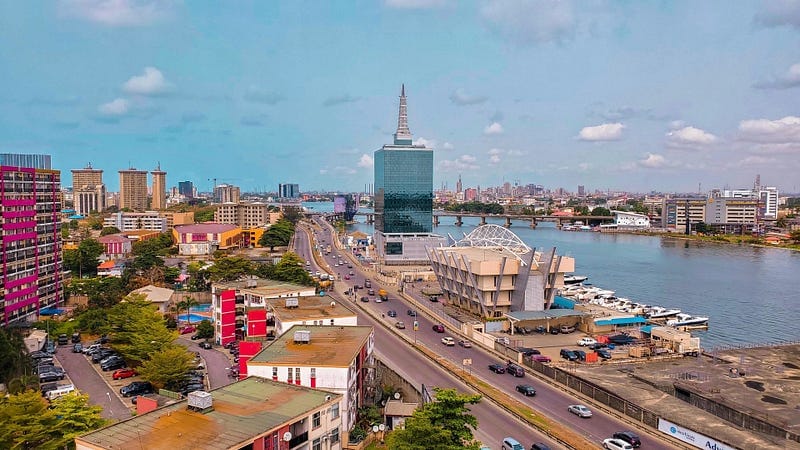
Ozumba Mbadiwe, Lagos.
I once helped an engineer friend visiting from the US make sense of Lagos. The city sang to him like a jazz band tuning up mid-street: off-key until you get the key. We walked, counted yellow buses like fireflies, negotiated with a sun that refuses dimmer switches, and I realized something simple: Lagos is a masterclass on systems theory delivered with car horns, generators, and Afrobeats. It breaks, then works, then breaks in a different way. You can’t study it from a balcony. You need dust on your shoe and data in your ear.
Most fields are like Lagos under the hood: medicine, education, payments, agriculture, banking, art. On the surface they have palaces; under the hood they have ports. The way to contribute isn’t to memorize the palace blueprint, it’s to learn the port schedule. Who docks when. How to greet. Where to check the manifest. Where the rules breathe.
This is where spiral thinkers thrive. We’re not always first to the neat answer, but we often see the second-order effect before the first-order has finished flexing. We see the conductor’s hand in mid-air and know the bus is about to swerve; we don’t need the memo.
A Closing Note From the Bus Door
The world rewards the illusion of certainty. The edges reward a different skill: grace under ambiguity. Feet steady, hand on the roof, eyes on the road, voice loud enough to carry without drowning the driver.
Build ports. Run loops. Spend your attention like it’s both rare and renewable. Delete bravely. And when the map argues with the road, be the conductor that taps the roof and chooses the lane.
If you’re already living at the edges, you know the secret: you don’t tame chaos; you collaborate with it. That’s not a failure of planning. That’s the real work.
Share this with the palace builders and the port keepers, the loop-runners and the line-lovers, the fast minds trying to make slower, truer moves. We’ll meet – somewhere between the bus and the road (the busstop?) – and trade notes.