Prelude
It was fifteen degrees outside. It felt like eight, according to the weather app. To everyone else who doesn’t live in The Great White North, it’s the kind of cold that makes you question your decision to even step out at all. To us, it was outdoor tennis time and although it was still cold, our decision was validated the moment our rackets made contact with the first ball. My wife and I had driven three minutes from our home in Toronto, to our local tennis court. We could have walked, but convincing my wife to walk in that cold is harder than playing tennis, so we drove. We were dressed for it. We were ready.
What we were not ready for was the situation of dog poop on the courts.
Not one pile. Several. Scattered across a court (3 courts actually within a wired fence) that sits inside a park surrounded, in every direction, by open green space specifically designated for dogs and their owners. The court itself has a sign, no, multiple signs, bolted, official, city-issued, that reads: no dogs allowed on the court. It is not a suggestion. It is a bylaw of the City of Toronto. And yet there it was. Evidence that someone (or some people) had brought their animal(s) into a shared public space, watched them defecate, chose not to clean it up, and then walked away. Shamelessly, might I add.
We cleaned what we could with our hands. Then we played. Because that is what you do when you love an activity like tennis so much. You adapt. You persevere. You tell yourself this is not the hill you will die on today.
But here is the thing about hills. Sometimes, right as you are done with your game and are walking back to your car, the hill comes right to you.
Part I. The “Confrontation”
As I got into the car, I saw a woman and her daughter walk into the court with a small puppy. That would have just been cute, except the dog was already squatting and I knew what was about to happen. I got back out of the car.
My wife was not pleased. She knows me very well, I will take every opportunity I get to effect a meaningful change, no matter how little and no matter how uncomfortable. But she also knows something else, something I will return to in detail in a bit, which is that when a Black man in a predominantly white neighbourhood gets out of his car to “confront” a white woman about a rule violation, the arithmetic of that situation is never simple. The variables are never just the rule and the violation. There are a hundred other variables, invisible to everyone except the man doing the walking, and his wife sitting in the car doing the watching.
I walked over anyway. Calmly. With what I hope was the bearing of a man who has decided that civility, principles and conviction are not in conflict with each other. I walked up to her and very politely asked if I could speak to her for a minute. I approached her politely and calmly. I am certain, however, that if she were to recount this story, my demeanor would be recast as something entirely different, because in these encounters, the objective truth is often the first casualty.
I told her, with due respect, that dogs were not permitted on the court. I told her I had just spent time cleaning up dog waste so that my wife and I could play. I told her the parks around us, visible from where we were standing, were precisely the spaces her dog was welcome. I also pointed her to the multiple city-hung signs that spoke my exact language.
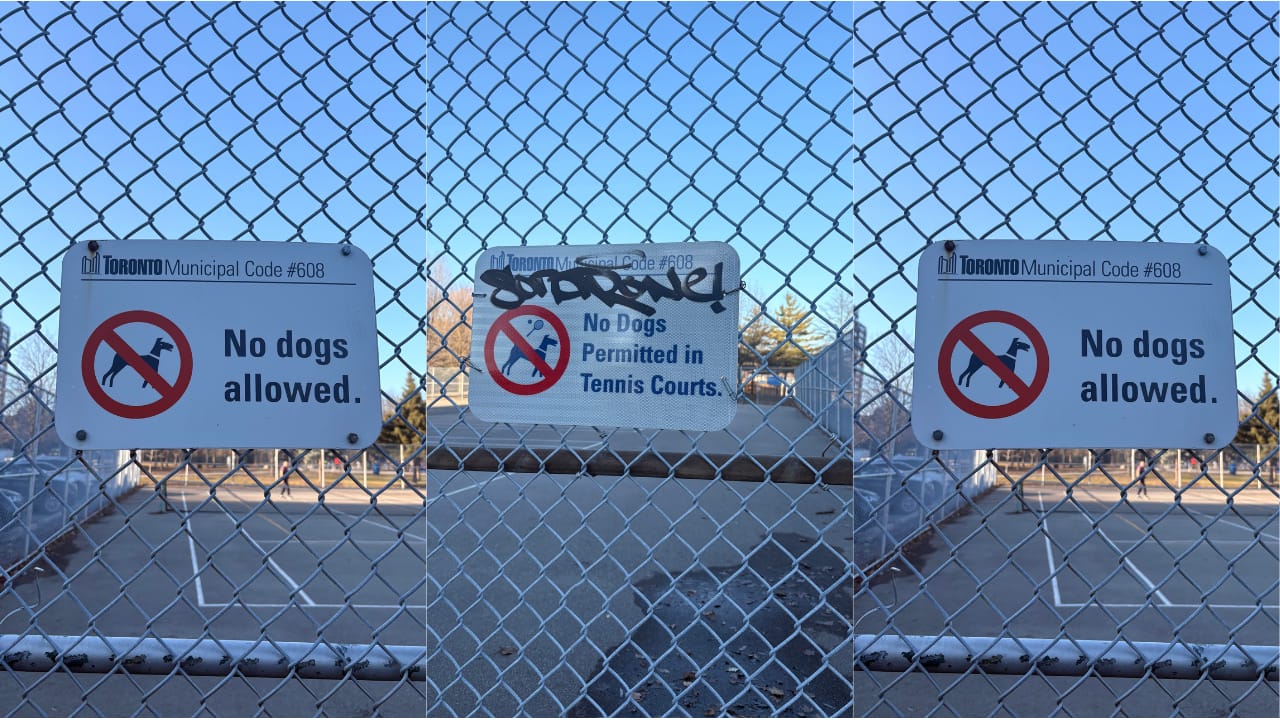
These are just 3 of multiple signs hung around the fence of the court. Photos taken by me.
Her response: “that was for people who didn’t clean up after their dogs.”
That was the problem and I made it clear. Regardless of whether you intend to clean up, the law says don’t bring the dog. The law is not conditioned on your intentions. The sign does not say ‘no dogs unless you promise to clean up.’ It says no dogs. Zero conditions. Period!
Her response is somewhat analogous to walking up to a person who was just about to run past a red light to tell them that’s against the law and they respond by saying “that’s for people who don’t know how to drive”. The absurdity of her defense was glaring. If citizens are permitted to selectively interpret which laws apply to them based on their personal intentions, the result is not a community; it is a chaotic society. I was born and raised in Nigeria and I’d like to think I know a little bit of what such a society looks like.
She accused me of shouting at her daughter. I was not shouting. Her daughter was not close. And even if I had been shouting, I was speaking to her, an adult, about what every reasonable adult knows is an adult matter. I am not in the business of frightening children. I love kids. But I am also not in the business of softening the edges of a legitimate complaint because a child is nearby. The child was not the one breaking the law. The adult was.
She said she could do whatever she wanted. To which I responded: you are right that I cannot physically stop you. But I can, and will, tell you that what you are doing is wrong. I will always do that. That is non-negotiable.
She hissed, muttered some words that I assume are insults and began to walk out. I didn’t care. I had passed my message and I thought it was over, so I also walked back to my car. I had made my point clear.
Then the husband arrived.
Part II. Go Fetch
He came in with the energy of a man who had been briefed and had decided that his size (he is big, not fit, but big; also not in a way that threatened me at all) or his skin, or his sense of belonging in this particular neighbourhood, on this particular day, was a sufficient argument. He had determined that they would return to the courts and perhaps, nothing would happen. He was wrong.
I got out of my car again and I approached him the same way I had approached his wife. Same tone. Same respect. Same directness.
I explained what had happened. I explained the sign(s). I explained that I was not asking anything unreasonable, only that they use the open park around us, which exists for precisely this purpose. I said this in the way one neighbour speaks to another about a shared resource.
He said he understood what I was saying. He said his six-year-old daughter had just gotten the puppy and the puppy just wanted to play. I’m also reasonable and in fact would have loved to play with the puppy myself because, as I said earlier, I also love dogs.
I said: I understand that completely. But I am not talking to the people I can see walking their dogs on the grass right now. I am talking to you, because you are inside a restricted space that was clearly labelled not for dogs and I also showed him the remnants of dog poop that were still all over the place.
He then told me “you’re not making sense, dude”. I thought he said he understood earlier, so I was visibly confused.
He told me to fuck off.
I told him he could do the same.
And then, then, he said, looking me straight in the eye: “ you dog!”
He didn’t stop there, I honestly wish he did because this essay would have been a bit pointless if he had just stopped there. Instead, he threw a stick toward me. Looked me in the eyes, again, and said: ‘You dog. Go fetch. Go fetch, boy. Go fetch.’
I want to sit with that for a moment. Because it deserves more than a moment.
A grown man, in front of his wife and his small daughter, looked at a Black man who had done nothing except quote a city bylaw and ask for basic civic consideration, and reached, instinctively, for the oldest, most primal racial dehumanization available to him. He did not reach for a counterargument. He did not reach for the name of the bylaw he believed contradicted mine. He did not reach for reason, or evidence, or even a well-constructed insult. He reached for the one thing that, in his mind, would put me in my place. He called me an animal. He threw a stick. He told me to fetch.
He did all this in front of his little daughter.
Part III. The Architecture of This Particular Insult
I want to be precise about what happened, because imprecision is how these moments get dismissed. What he did was not an accident of anger. When people are purely angry, untethered from ideology, they reach for generic insults. They call you an idiot. A jerk. They tell you to mind your own business. They do not, in the heat of an unplanned “confrontation” about a dog bylaw, spontaneously construct a racial tableau involving a thrown stick and the command to ‘fetch’, unless, and only unless that tableau was already assembled somewhere in their mind, waiting for an occasion to be deployed.
The specific shape of this insult, the dog metaphor, the stick, the command, all draw from a history so long and so well-documented that I need not rehearse all of it here. You can read about the Jim Crow era if you want to understand what that looks like. What I will say is this: when a white man cannot win a logical argument with a Black man, and chooses to respond by reimagining that Black man as a dog, he is not improvising. He is reaching into an inheritance. One that is not earned but assigned and claimed intentionally.
As soon as I got home, I made a video about the incident and posted it on TikTok and some other “Nigerians in Canada” account on Instagram decided to repost without any permission. Anyway, the response from other Black people was immediate, uniform, and rooted in a shared, exhausting survival instinct. The consensus was clear: avoid confrontation by any means necessary.
They reminded me that I wasn’t law enforcement , warned me not to be a hero, and pointed out the grim reality that ‘people have been shot for less’. The overarching message was a plea for self-preservation, fueled by the knowledge that in these situations, the narrative is almost always turned against us.
I reject the idea that I should have avoided this outcome by approaching him more gently, avoided the situation altogether, or just reported to the authorities and kept it moving.
I approached him the same way I would approach any neighbour, any human being, who was doing something that affected the shared commons. I was not aggressive. I was not threatening. I was not loud. I was direct, because directness is what a straightforward civic situation calls for. The notion that I owe an extra layer of softness or an additional coat of non-threatening-ness because of the combination of his whiteness and my Blackness, is itself a kind of subordination I refuse to perform. More on that later.
Bad things happen because good people stay quiet. I am not particularly interested in being the kind of good person who decides that silence is the price of safety. I am, as I said to some people in the comment section of my TikTok post, unpredictable in my own right.
Part IV. This Is Not a New Story
In 2020, a man named Christian Cooper was birdwatching in Central Park in New York City. He asked a woman named Amy Cooper (no relation) to leash her dog, as the park rules required. She called the police and told them an ‘African American man’ was threatening her life. She was not threatened. She was simply confronted, by a Black man, about a rule she was breaking. Her response was to weaponize the state against him.
Christian Cooper did not raise his voice. He did not touch her. He began filming because he understood, as every Black person in a white space understands, that his word alone would not be sufficient. His body, his presence, his Blackness was read as a threat the moment it asserted a right. The woman understood this too. That is why she made the call.
What happened to me was different in mechanism but identical in grammar. The man in Toronto did not call the police. He called me a dog. Different instrument, same music: the reassertion of a hierarchy that his argument could not defend.
In June 2020, two Black women (Deborah Ampong and Eva Amo-Mensah) went to Centennial Park in Etobicoke for a morning workout. When they finished, they hopped a fence to exit. So did two white teenagers, at the same moment, in front of the same bylaw officer. The officer stopped the Black women. He did not stop the teenagers. He demanded their ID, attempted to photograph their licence plate, and told them that if they had been trespassing on his private property, he would be licensed to shoot them. An independent investigation commissioned by the City of Toronto concluded that race was a factor and that the officer had breached the Ontario Human Rights Code. The Toronto Ombudsman confirmed it publicly in 2021.
I raise this not to present the women as flawless. They did hop a fence in a closed area, which they should not have done. I raise it because that is precisely the point. The question was never whether they were perfect. The question was whether the law would be applied to everyone who broke it equally. It was not. And the officer, when he ran out of justification, reached for something older and uglier than the bylaw he was supposed to be enforcing.
Different instrument. Same music.
These stories share a similar structure. A Black person occupies a public space with the same rights as anyone else. They either assert those rights, or simply exist while holding them. A white person, for reasons that usually have nothing to do with the ostensible conflict, decides this is unacceptable. And when confronted with the failure of their logic, they reach not for better logic, but for power; social, institutional, or symbolic. And in almost all recorded cases, the law is never the friend of the black person in the scenario.
The symbolic form of that power, the insult that reminds you what they really think of you, is perhaps the most honest. At least it drops the pretence, and as ugly as it is, I appreciate that a bit more than pretending the law exists to protect us all equally.
Part V. I Am Not a Victim. Let Me Be Clear About That.
I am doing exceptionally well. I say this not to boast, but because it is relevant. I am a Lead Product Manager at a publicly traded fintech company. I live in a comfortable home in Toronto. I am well educated, well travelled, and genuinely happy with the life I have built. I do not navigate this country from a position of fear or fragility. I do not wake up in the morning expecting to be racially abused, and when it happens, as it did on a dry tennis court on a cold Sunday in March, it does not shatter me. I won’t have even cared if there wasn’t a kid somewhere witnessing this happen. More on that later.
What it does is clarify something.
It clarifies that Canada’s unfinished work is not primarily about whether Black people (or people/immigrants of color in general) can succeed here. Clearly we can. We’ve bought homes, built businesses, created jobs, and even hold government positions (although not as much to be considered true representation).
The unfinished work is about what happens in the unscripted moments. The parking lots and tennis courts and park benches when a white person’s authority or activity is questioned by a Black person and they have to decide, in real time, what they actually believe about the equality they claim to support.
The man who told me to go fetch probably considers himself a reasonable person. He probably does not think of himself as a racist. He almost certainly voted for or supports politicians who speak the language of inclusion (I hope he voted for Mark Carney who is showing the world true leadership in these uncertain times). He may have Black colleagues he respects, Black public figures he admires. And yet when the moment came and a Black man stood in front of him and refused to move, refused to soften, refused to make himself smaller, the stick came out, and so did the words: “Go fetch, boy!”.
That gap, the one that exists between the self-image and the reflex, is where Canada’s work lives.
Part VI. The Daughter. The Future.
This has been a long essay but I am less interested in the man than I am in the girl.
She was six years old. She had a new puppy. She was having what should have been a joyful Sunday in the park. And instead, she watched her father throw a stick at a Black man and tell him to fetch.
I have thought about her more than I have thought about him because I understand very well that children are not neutral observers. And to be clear, I have also thought very hard about my part in making her witness that horrible situation but this is not my story. More on that later.
Children who witness their parents deploy racial violence, even verbal racial violence, are not neutral observers. They are absorbing a curriculum. The question is only which lessons they take from it. And the possible lessons form a spectrum, none of them are really clean. But maybe, just maybe, there may be one clean outcome.
She may grow up carrying guilt. Not guilt she earned, but the inherited kind. The guilt of belonging to a family she eventually comes to understand differently than she does today. That guilt, if it calcifies, produces its own distortions. It produces white people who treat Black people (or people of color in general) with exaggerated warmth, a performative kindness designed to say: I am not my father. But overcorrection is its own form of objectification. You are not treating a person as a person when you treat them as an opportunity for your own absolution.
She may grow up avoiding Black people altogether. Not out of hatred, but out of a shame she cannot articulate. She does not want to be associated with what she saw that day. The cleanest solution, her nervous system decides, is distance. But distance, when it is racially organized, is segregation by another name. That segregation in the case of this little girl, is keeping only white friends to avoid a possibility of offending Black kids, but that same segregation in the case of South Africa in the 90’s was called Apartheid.
Or, and this is the version I am most worried about, she may internalize the lesson her father intended. She may grow up believing that when a Black person challenges her, in any context, about anything, the appropriate response is the reassertion of superiority. That the hierarchy is real. That the metaphorical stick is always available. Throw it and ask them to “Go fetch.”
The version I hope for however, though it asks a great deal of a six-year-old, is that she grows up to be the person who eventually understands what she saw, names it clearly, and refuses to carry it forward. That version requires more from her than it should. But it is possible. Children have surprised their parents’ legacies before and I choose to retain the optimism that this outcome is possible for the little girl.
Whatever she becomes, she did not deserve to be made a witness to that moment. And the responsibility for that, entirely and without qualification, belongs to her father.
Part VII. I Am Not a Saint. That Is Not the Point.
I want to pause here and say something that I think is important, because the internet will find it anyway if I do not say it myself: I am not a perfect person. I have broken rules. I have been selfish, careless, inconsiderate. There are almost certainly moments in my life where someone, had they been watching, would have been fully justified in tapping me on the shoulder and saying: excuse me, you are doing the wrong thing. Maybe even as recently as the day I chose to correct the man and his wife.
I know this about myself. I live with it the way all honest and principled people live with their own contradictions; not comfortably, but clearly. I watched J. Cole, an artist I respect a lot for his principled and humble life, talk about how he wrestled with this contradiction after he dropped the “7 Minute Drill” diss track which he eventually deleted and apologized to Kendrick Lamar for. You can find the Apple Music x Nadeska Alexis interview here.
And so if anyone reads this and their first instinct is to say: well, but you are no saint yourself, they are probably right. And they can, with my sincere regards, mind their own business and keep it moving.
Because that is not what this is about. The argument that you must be morally perfect before you are permitted to hold others accountable is one of the most convenient arguments ever invented by people who do not want to be held accountable. It is infinitely expandable. It can be applied to anyone, at any time, to neutralise any objection. It is not a principle. It is a deflection. A very lazy deflection too.
The actual principle, the one I try to operate by, is simpler and more useful: every time you have an opportunity to push the world toward what is right, you take it. Not because you are better than the person you are correcting. Not because your record is clean. But because the act of speaking, of saying this is wrong and saying so out loud, does two things simultaneously. It holds the other person accountable. And it holds you accountable too. It reminds you, in the act of insisting on the standard, that the standard applies to you as well.
Speaking up is not self-righteousness. It is a form of self-discipline. A harder form of self-discipline than choosing to stay quiet.
I have gone back and corrected mistakes I made when no one was watching, partly because I had spent time telling other people to do the same. The two things are connected. The person who stays silent in the face of wrong, who decides that their own imperfections disqualify them from the conversation, does not become more virtuous for their silence. They just become quieter. And a quieter wrong is still wrong.
So yes. I am not a saint. But in the face of another wrongdoing around my community, tennis court or not, I will still get out of the car and speak against it.
Part VIII. On the Obligation to Speak
I know what some people will say. They will say I escalated the situation by going back a second time. In fact, they already said that. They will say that, as a Black man, I should have been more careful about how things might look. They will say that the wise move was to document it and report it and let the system handle it. The same system, I might add, that Christian Cooper had to film himself surviving in real time.
I reject this counsel entirely. I said a lot about this earlier.
Not because I don’t respect the law or processes. Not because I am reckless. Not because I do not understand the risks. I understand them precisely. I understand them in the specific, embodied way that someone understands them when they have had to calculate the variables every time they assert a basic right in a space that was not designed with them in mind. I made the calculation. I made it clearly. And I decided that silence was not an option I was willing to live with.
There is a version of ‘stay safe’ that is, in practice, ‘stay small.’ I do not live in that version.
The moral argument for speaking is, I think, fairly simple. If people who break civic rules face no social consequence, no moment of being told, by a neighbour, that what they are doing is wrong, then the only enforcement mechanism is official. And official enforcement, as we well know, is selective, slow, and not equally accessible to everyone. The informal social contract, the one where we hold each other accountable, neighbour to neighbour, citizen to citizen, depends on people being willing to actually speak. To actually say: what you are doing is wrong, and I am telling you so, and I do not care what it costs me.
I am that person. I was that person before this incident. I will be that person after it. If the man returns to that court with his dog, I will approach him again. Same tone. Same clarity. Same refusal to be moved. Hopefully, this time, I’ll remember to take out my phone and actually record it because Black people always need hard evidence, which, ironically, is another evidence of the selective justice system.
Part IX. What We Owe Each Other. Here, and Everywhere
Canada is a remarkable country. I mean this without irony or performance. It is a country that, at its best, has built something genuinely uncommon. A pluralist society that functions, mostly, in good faith. I did not move here reluctantly. I moved here because I believed in the project.
But I also moved here knowing what I was moving from. And that knowledge is not incidental to this story. It is the whole second half of it.
I grew up in Lagos, Nigeria. I know, in a way that is not theoretical, what happens when civic order is allowed to collapse. When the people who are supposed to enforce the law are the primary violators of it. When the police do not protect you and they become the threat you are protecting yourself from. When the powerful break rules openly, in front of everyone, and the lesson that settles into the population is: laws are for other people. Laws are for the weak. If you have money, or connections, or the right uniform, the law does not apply to you.
I have seen what that produces. It produces a society where the best people; the most talented, the most ambitious, the most capable of building something or even changing society, eventually make a calculation. They look at what is around them, and they look at what could be, and they decide that the gap is too large to bridge from inside. And so they leave. They come to places like Canada. Places that, by reputation and by experience, feel like somewhere the rules actually mean something. Somewhere the sign that says no dogs means no dogs. Somewhere you can play tennis on a public court without cleaning up after someone else’s animal first, or at least have some recourse if you do.
In Nigeria, we call it, sometimes with a self-awareness that borders on embarrassment, ‘saner clime.’ Better place. Place where things work.
And here is the thing I cannot stop thinking about: what happens when you arrive at that saner clime, and the saner clime begins to look like the place you left?
Not in the obvious ways. Canada is not Nigeria. I am not suggesting otherwise. But the erosion of civic norms does not begin with a coup or a collapsed institution. It begins with a man who walks his dog into a restricted court because he does not feel like the sign applies to him. It begins with the assumption that accountability is for other people. It begins with the decision, made in small moments, in parking lots and parks and tennis courts, that the rules of shared space are optional for those who feel sufficiently above them.
I have watched a country fail, in slow motion, because enough people made enough of those small decisions, and enough other people said nothing. I know what it looks like at the beginning. I know what it looks like in the middle. And I am not going to be the person who keeps quiet while it starts. Don’t worry, I know it didn’t start here in Canada today, but for me, it did.
This is why the man with the stick bothers me less than the silence around him. His wife watched. She said nothing. The daughter watched. Other people, in other moments like this one, see and say nothing. People in the social media comments encourage you to keep quiet, mind your business, stop playing victim, etc. And the man learns, from the silence, that he can do it again. That the stick is available. That the hierarchy holds.
I came to Canada because I believed in something better. I intend to help keep it better. That is not a favour I am doing for Canada. It is the reason I am here.
What we owe each other, in this country, and in every country that aspires to be a place where the rules mean something, is the willingness to be disturbed. To be corrected. To stand in a shared public space and accept that it is, in fact, shared. That the rules apply to all of us with equal force, regardless of who is doing the correcting and who is being corrected.
That is a small thing. It is one of the smallest things we could possibly ask of one another. And it is, apparently, still too much for some people to manage.
Part X. What I Am Asking For
I am not asking for sympathy. I do not need it, and in any case it is not particularly useful. Not for me, not for anyone.
I am asking for clarity. I am asking that we, as a society, stop treating the Femi-gets-out-of-his-car moment as an exception, as a regrettable but isolated incident, and start treating it as data. As information about who we are and what we still need to become.
I am asking that the man who told me to go fetch understands, if he ever reads this, which I doubt, that he did not diminish me. He revealed himself. He revealed himself to his wife, who watched in silence. But maybe she already knew. He revealed himself to his daughter, who was six years old and will be processing what she saw for longer than either of them will admit or even be alive long enough to witness or apologize for. He revealed himself to me, though I already knew enough.
I am asking that we build communities, physical communities, neighbourhoods, courts and parks and shared spaces, where the civic contract is taken seriously. Where the sign that says no dogs means no dogs. Where the person who points at the sign is not met with a stick.
And I am asking that we raise children, especially children who look like that little girl, who are taught that the way you respond to being wrong is not to dehumanize the person who corrected you. That losing an argument about a bylaw or anything for that matter, does not entitle you to reach for anything. That power, real power, durable power, the kind worth having, does not need to throw a stick to prove itself. It exists in the principles you hold, the values you live by and your eventual actions.
The court dried. We played tennis. My wife, despite her initial disagreement with my approach, admitted afterward that she understood why I had to do it.
I will be back on that court in the summer. It is three minutes from my house. And while I am seriously hoping I won’t have to clean up animal waste just to hit a few tennis balls, I am even more hopeful that I won’t have to clean up the mess left behind by someone else’s entitlement.