Prelude.
I’m a huge fan of tennis. I love the sport (sports in general, but tennis specifically holds a special place). I often introduce myself in professional environments as a part time product manager and a full time tennis enthusiast (even in interviews, the audacity). The intensity, the difficulty, the cardiovascular benefits, the entertainment. Everything! I watch every competition I can, from Grand Slams to WTA 500 matches. I consider it to be the ultimate sport in the world and perhaps the only remaining Gladiator sport. I also play the sport, and although I enjoy it every time, it frustrates me every time. It’s a brutal sport to play and to master, and somehow that’s exactly why I love it.
It’s also the reason why I’m writing this essay.
Tennis is, or can be, a very entertaining sport for those who watch. But it can also be brutally difficult to master for those who play it competitively and for that reason, there has always been a debate, or a tension, between craft — skill, dynamism, creativity, however you want to qualify it — and efficiency. Some believe in the idea that true mastery is just about winning on the scoreboard and everything else is secondary and others (maybe myself included — sometimes) believe that winning the game is just as important as winning everything else involved in the game (the crowd, the kids, the renewal of your own love for the sport, the respect from your opponent either for your creativity & mastery or for your sportsmanship).
But should there even be a debate? It all feels like a false choice, just as it feels in any other life endeavour, and that’s the core argument that I want to challenge with this essay.
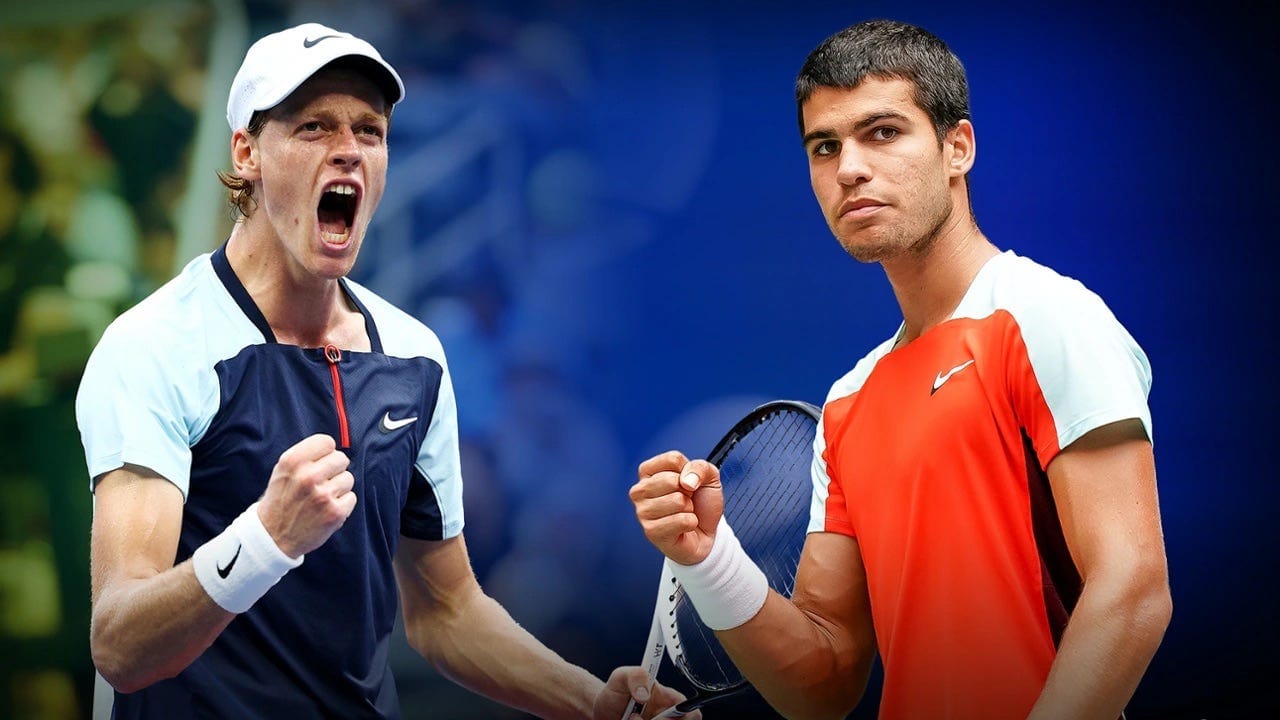
Jannik Sinner (left) & Carlos Alcaraz (right) at the US Open Quarter-final 2022. Source: usopen.org
Two Men, One Sport, Zero Agreement.
There is this moment in a Carlos Alcaraz match that I have watched, in some variation, more times than I can count that is always fascinating in almost every form. He is in the middle of a rally. The ball is mid-court, floating, gift-wrapped. Any competent professional would punch it cross-court for a clean winner. Alcaraz sees this. He knows this. And then he does something else entirely. A tweener, a drop shot from behind the baseline, a squash-like forehand, a between-the-legs flick that has absolutely no business existing in a competitive Grand Slam semi final match when the scoreboard is 2–2: 40–40 and he’s playing for the advantage. Sometimes it goes in. Sometimes it doesn’t. In both cases, he grins.
The crowd loses its mind either way. Or maybe some get a mini heart attack.
Now consider Jannik Sinner. Same tournament bracket, different aesthetic universe. Sinner does not grin. Sinner does not attempt shots that have no business existing. Sinner hits forehands and backhands that are so mechanically perfect they feel almost algorithmic — a process so optimized it has almost transcended effort. Many players have even referred to him as a ball machine in interviews, and you hardly ever beat a ball machine that’s well set up.
Sinner is always well set up. He does not go for the highlight. He goes for the result. And the result, more often than not, is that his opponent is running desperately to retrieve a ball that was already, from the first stroke of the rally, doomed. He doesn’t just win, he crushes his opponents and is evident in how he serves up bagels (which, in tennis terms, means winning a set of tennis without losing a single game). He served up the most bagels in 2025 (10). Alcaraz came in second (8).
Sinner wins. Alcaraz wins. They have split the last nine Grand Slams between them. They have traded the world number one ranking like a baton neither wants to drop.
And yet the conversation people cannot stop having — on tennis threads, on Reddit, in Twitter (or “X”) debates, in the kind of arguments that starts at a bar and ends with someone pulling up YouTube to prove a point is always this: which one is better?
I want to suggest that this is the wrong question. In fact, I believe very strongly that it is, in fact, the wrong question. Not because the comparison is unfair. But because the question itself is built on a false premise; that there is only one scoreboard, and both men are playing on it.
What We Talk About When We Talk About Style.
Imagine a perfectly emulsified, velvet-textured potato leek soup (I only know this because my wife is a master of recipes — you should check out her Instagram & Youtube channels). The flavor is balanced, the temperature is precise, and the silkiness is flawless. Then, right before it leaves the pass, the chef places two perfectly parallel, 1-inch snips of chive across the center. The chives themselves don’t change the flavor, but they change the experience of receiving the dish, and that experience is part of what a great chef is doing.
Style, in competitive contexts, gets a bad reputation. It is treated as decoration. The thing you add when you have already secured the result. That garnish on a dish that only matters because the food underneath it works.
In this framing, style is a luxury. Efficiency is the substance. You earn the right to play beautiful tennis only after you’ve demonstrated you can win ugly.
This is the argument that gets made, and it almost sounds reasonable until you look at what it is actually saying.
It is saying that the crowd who paid for a ticket is irrelevant to the value of the match. It is effectively saying that the athlete’s experience of performing (the joy, the creativity, the sensation of attempting something difficult and feeling it work) is incidental noise, not signal. It is saying that sports exist purely as a competition to be decided, and that everything else that comes with it, the history, the artistry, the reason anyone outside the two competitors’ families cares, the reason why I wake up at odd hours to watch the Australian Open, is just context, inconsequential to the value of the sport.
That is a strange thing to believe about a sport. It is an even stranger thing to believe about any human endeavor.
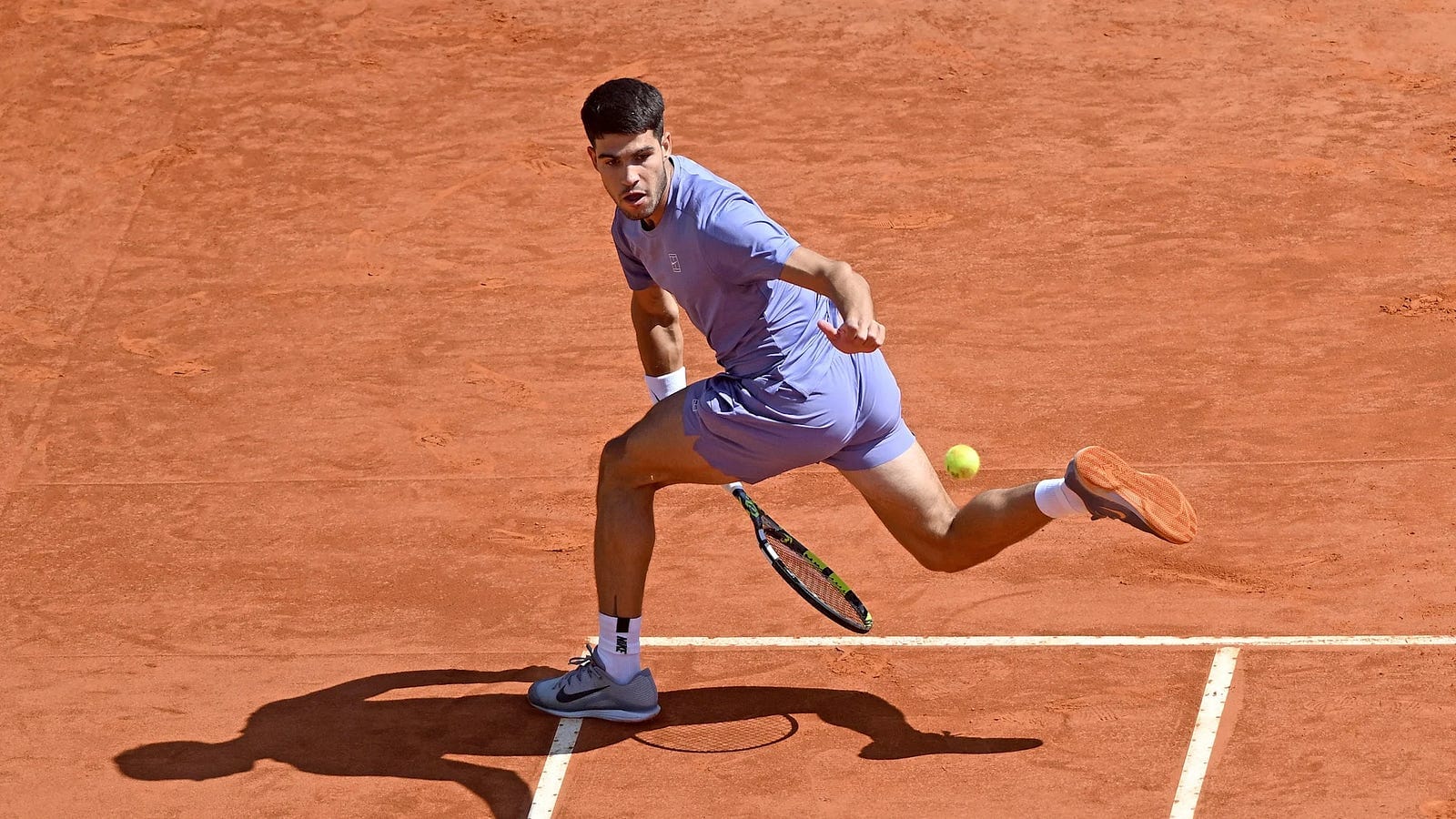
Carlos Alcaraz incredible running tweener at Monte Carlo Masters. Shot of the year 2025. Source: si.com
Carlos Alcaraz has said, in various interviews and in various phrasings, that he wants people to enjoy watching him play. This is not false modesty. It’s not even modesty at all (although, as a person, he’s one of the most modest in the sport in general). He means it mechanically: he makes shot selections specifically because they are entertaining, knowing full well that the percentage play was available. This is a deliberate creative choice. He is not choosing between winning and losing. He is choosing between two ways of winning, and picking the one that adds something beyond the result that is only visible on the scoreboard.
Sinner, by contrast, has said almost nothing that suggests he thinks about this at all. His stated goal is improvement. His stated method is work. His stated horizon is the next match. He is not indifferent to winning; he is consumed by it. He just does not appear to require anything else from the experience. Every interview, every post-match speech references the same thing. Next practice, next point, next game, next win. There’s always something to improve and that’s always where his attention goes.
These are not two men disagreeing about how to play tennis. These are two men with fundamentally different beliefs about what playing tennis is for. More on that later.
The Efficiency Trap.
Here is what the pro-efficiency argument gets right: results matter. A beautiful loss is still a loss. A player who entertains the crowd but exits in the second round has not, in any meaningful competitive sense, achieved what the competition is for. Craft divorced from outcome is performance art, not sport. These kinds of exits happen a lot to Carlos, but they also happen to the ultra-efficient Jannik.
But here is what the pro-efficiency gets wrong, and this is the part that tends to go unsaid: efficiency is not neutral. It has costs that do not appear on the scoreboard.
The most efficient version of almost anything is also, typically, almost without exception, the least interesting version. The most efficient conversation is a transaction. The most efficient meeting is a memo. The most efficient tennis match is a machine serving balls at a wall. Maximum efficiency tends to eliminate the qualities that make something worth doing beyond its immediate purpose. The friction, the creativity, the possibility of something unexpected, maybe even magical, happening.
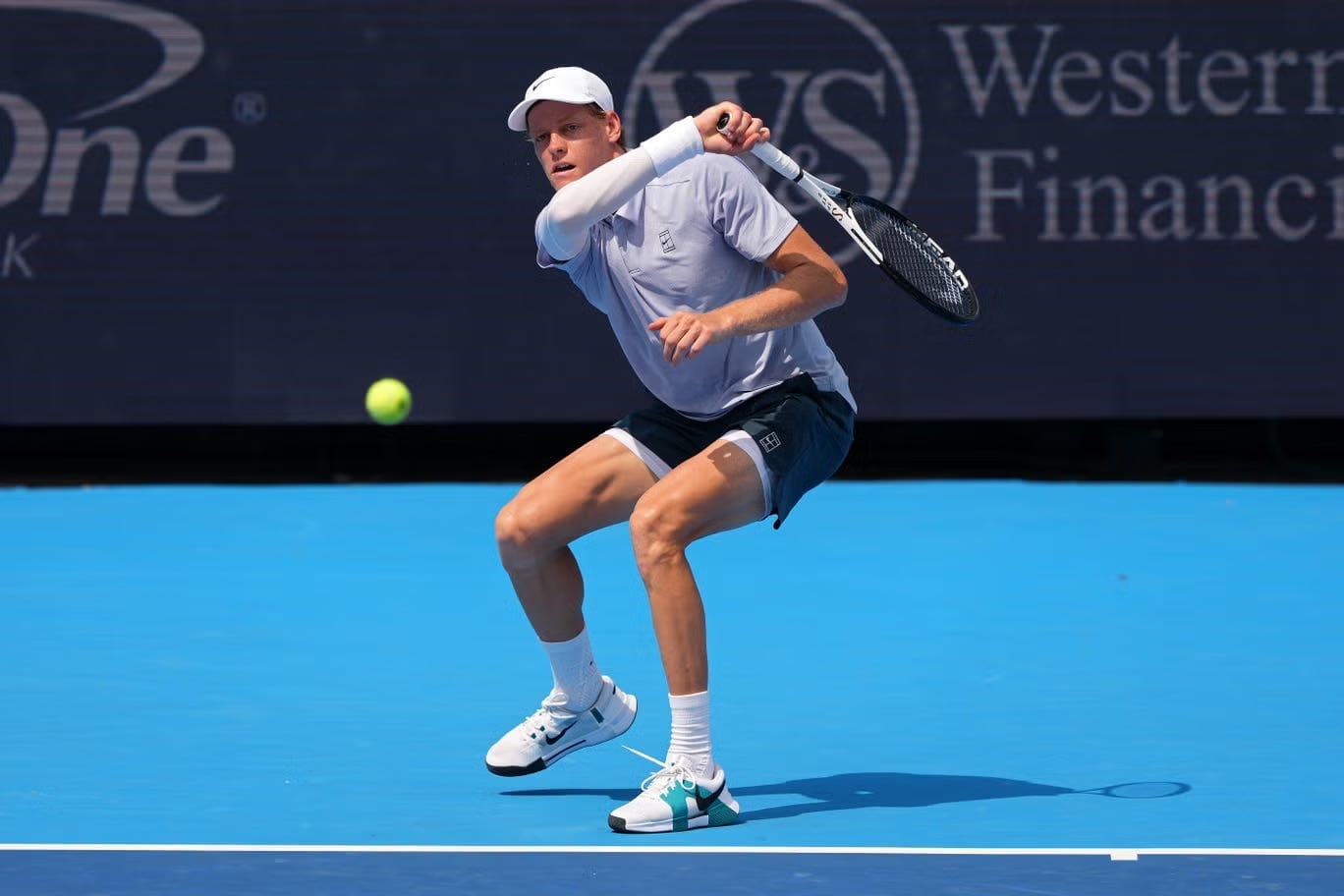
Jannik Sinner crushing the ball at Cincinnati Masters 2025. Source: Independent.co.uk
Sinner’s tennis is not quite at that extreme. He is still a human being performing at an extraordinary level, and there is genuine beauty in the precision of what he does. But there is a reason the phrase “Sinner is boring” exists in tennis discourse and the word boring is hardly ever used in the same sentence as Alcaraz, and it is not jealousy from Carlos’ fans. It is a real observation about what is and isn’t present in his game. The unpredictability, the creative risk, the sense that you might witness something tonight that you’ve never seen before. That feeling is not there. What is there is mastery, and mastery, at a certain altitude, can start to feel inevitable.
Inevitability, it turns out, is not very interesting to watch.
Alcaraz gives you the opposite. He gives you the feeling that anything might happen — including losing. And this is not a weakness in his game. It is, arguably, the most honest thing about it. He is reminding you that tennis is hard, that even the best players in the world are attempting things that might fail, and that the attempt itself is part of what you came to see. It is those things that he attempts, pass or fail, that you leave the match thinking about, and if you play tennis like me, also attempt — and mostly fail at — on your local home courts.
The Professional World Has This Same Argument, Badly, Sadly.
Take this into any office, any team, any professional context, and the debate reproduces itself almost exactly.
There is always a Sinner type in a professional environment. They deliver. They are reliable. They do not overreach. They produce outcomes that are clean, measurable, and consistently on time. They are not especially warm in meetings. They are not particularly interested in how the work feels, only in whether it works. If you need something done and done correctly, you give it to this person, and you do not worry about it.
And there is always an Alcaraz type. They take longer, sometimes. They come back with something you didn’t ask for; a reframing of the problem, a different entry point, an angle that wasn’t in the brief, or something completely off the brief. Some of it lands brilliantly. Some of it needs editing back toward the original direction. They make the work more interesting, occasionally at the expense of the work being simpler. They care, visibly, about how the output feels to whoever receives it and not just whether it resolves the request.
Most organizations, if you press them, will tell you they want both. And most organizations, if you watch them, reward only one.
The performance review systems, the promotion criteria, the metrics dashboards, everything within the organization are built to capture Sinner outputs. Deliverables met. Timelines held. Quality scores above threshold. These are things you can count. What you cannot count, at least not as easily in a column on a spreadsheet, is the meeting that went somewhere unexpected because someone asked a question nobody had thought to ask. The proposal that reframed the client’s problem and won trust that no invoice could have bought. The moment a team realized they were working on something worth caring about, not just something worth completing.
These are Alcaraz moments. And they do not fit neatly into any rubric.
The result is a quiet institutional bias that runs so deep most people inside it cannot see it from where they’re standing. The bias is not against creativity, exactly. The bias is against unmeasured or unmeasurable things. And creativity, by its nature, resists easy measurement. So it gets discounted — not consciously, not maliciously, but systematically. The Alcaraz types eventually learn to bury the drop shots. They learn that the organization rewards the clean cross-court winner, so they start hitting those instead. Over time, they stop reaching for the other shots at all. They drop the polish and opt for the quick delivery even if the cost is the soul that it gives to the proposal, document or memo. The organization doesn’t really punish the drop shot, it just never rewards it. Over time, that’s the same thing
And then, one day, a leader in that organization looks around and wonders why nobody is bringing them anything interesting anymore. Well…
The Question We Should Have Been Asking Instead
The debate between style and efficiency is a seductive one because it feels binary, like it has a right or wrong answer. Either beauty matters or it doesn’t. Either craft is intrinsically valuable or it’s just decoration. Either Alcaraz is playing “better tennis” or he’s playing “riskier tennis” for no justified reason.
But this is a false binary, and the falseness of it is the whole point.
The real question is not which is better. The real question is: better for what? And why?
Sinner’s approach is better for one version of tennis. The version where the only thing that matters is the final scoreline, where the measure of a match is who won, and where the experience of playing and watching is secondary to the result. It is a completely coherent philosophy. It is also a philosophy that, if applied universally, would produce a sport nobody wants to watch, because it evacuates the human uncertainty that makes competition worth following.
Alcaraz’s approach is better for a different version. The version where the sport is also a conversation between the players and the crowd, where the outcome matters but is not the only thing that matters, where the willingness to attempt something difficult is itself a form of integrity. This philosophy is also equally coherent, except that its universal application still retains the uncertainty that makes the sport worth the price for tickets.
Neither of these is wrong. They are answers to different questions.

Source: iStock
The problem is that we keep forcing them into competition with each other on a single metric. As if tennis, or work, or creativity, or any human endeavor that can be done well or poorly, has only one definition of well.
It doesn’t.
There is no universal scoreboard. There are different things people are trying to accomplish, and different methods that serve those different goals, and the sophistication of any judgment about quality depends entirely on whether you’ve bothered to ask which game is actually being played.
Sinner is winning the game he set out to play. Alcaraz is winning a different game, on the same court, at the same time. The crowd, at least, knows this. They cheer for both of them, but they do not cheer for both of them in the same way.
Maybe that is the only verdict that matters. Not who is objectively better. But what, exactly, each of them is making possible, and more importantly, whether the world you want to live in has room for both.
I believe it does. I believe, in fact, that it needs both.
What I don’t believe is that we get to keep pretending there is only one way to be excellent.
Femi Siji-Kenneth writes about product, culture, tennis, people, and the gap between how things work and how they could. You can find me on any platform @ifemora